
ASK THE WORK
The one in which I have an argument with Stephen King (and win)

There is an unsubstantiated rumour that my office is filled not just with wall-to-wall bookshelves but also boxes of books
(on the floor, in the way)
Most are about writers.
Specifically: how writers work.
One of these books - Stephen King’s On Writing I have inhaled over and over since it came out in 2000.
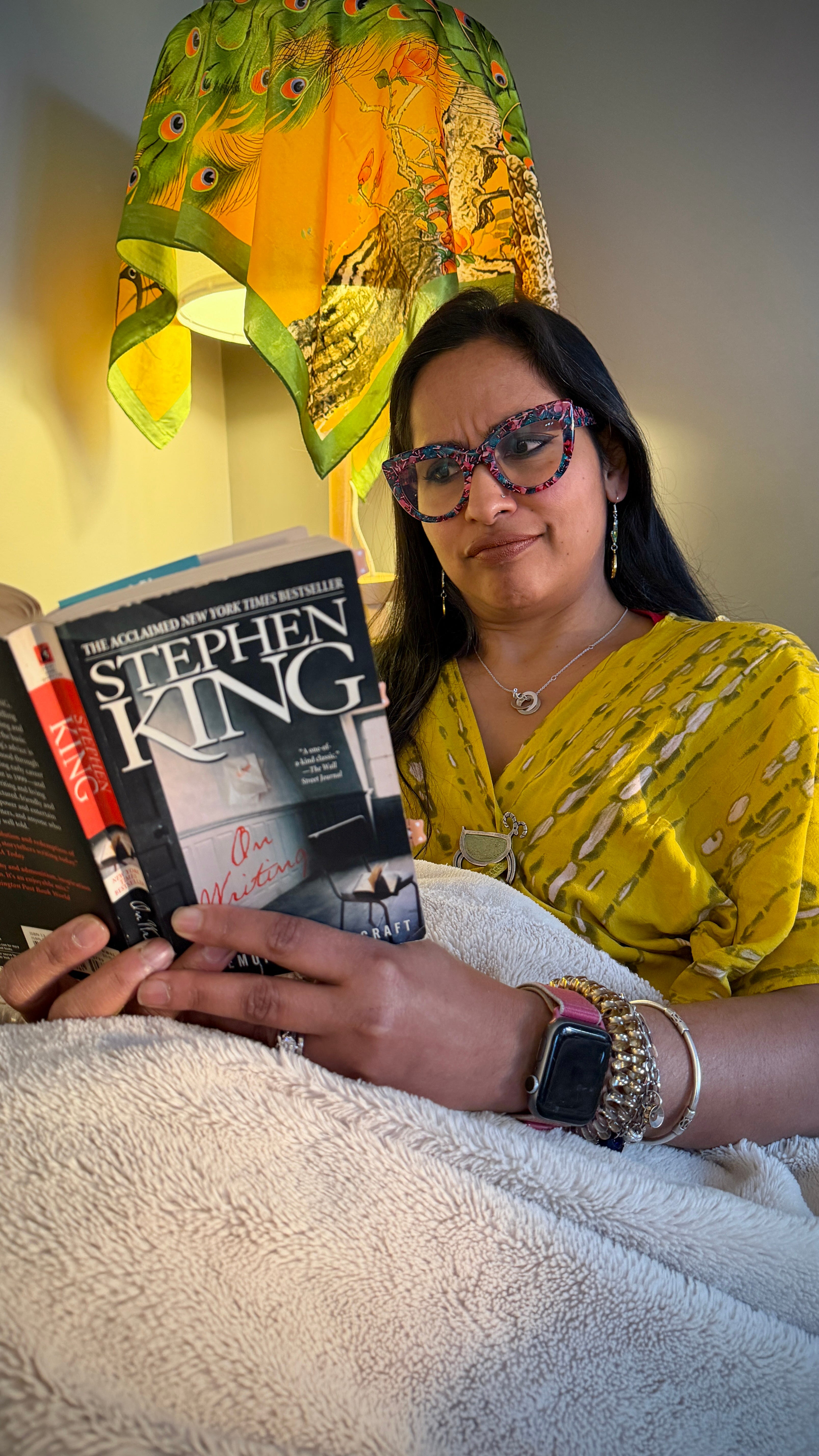
I love that book. Truly.
His backstory.
His humour.
The writing instruction.
And yet, over time, in what I can only assume is a sign of personal growth, I have come to disagree with almost everything King tells me to do.
He has Opinions:
Write every single day.
Ideally for 3-4 hour chunks.
Don’t outline.
Adjectives should be treated like warts.
Look, Stephen, I don’t mean to be disrespectful, but I have kids. I have to work to pay the bills. And I don’t have a wife whose primary task is (or was for a season) to protect my writing time.
Also, on the rare occasions I manage to carve out a marathon writing block, my muse usually kicks me in the crotch, spills my tea and runs off giggling.
I’m sure Cal Newport is judging me.
What has actually worked better for me is kinda… undramatic.
It’s writing in small sips.
All the time.
Any time.
A sentence (or two) while waiting in line at the grocery store.
Risking frostbite to type out a particularly juicy metaphor on a walk in -20 C weather.
Index cards tucked into the 5 books I’m reading simultaneously.
This method has converted my phone from enemy into ally.
I learned to write this way deep in the throes of Chronic Fatigue Syndrome, when my brain and body felt wrapped in cotton and then thrown in a blender.
That experience put me on the hunt for other writers who have bent process around their reality instead of the reverse.
One such writer, now my mentor, is Esmé Weijun Wang. She’s a NYTimes bestselling author and regular Substacker despite the almost unfathomable challenges of living with schizoaffective disorder and late stage Lyme disease.

Okay Stephen, let’s talk about pantsing…
In Writing Creativity and Soul, Sue Monk Kidd tells the story of losing a year and a half trying to write The Secret Life of Bees without an outline after a workshop leader warned that structure would kill her creative spirit.
But without structure Kidd felt lost.
Confused.
Rather than declaring allegiance to either camp, Kidd did something radical: she stopped arguing with the rule and started paying attention to herself.
Sometimes knowing where the story is going helps.
Sometimes it strangles discovery.
Listen to Sue, Stephen!
Or actually, don’t. Just listen to the work and forget the rules.
I’m a natural pantser, like you Stephen, but when a project starts to sprawl or lose its pulse, a little structure feels like kindness, not betrayal.
One of my favourite workarounds comes from Michael A. Ronn, who outlines after he writes. He lets the work roam first, then maps where it’s already been.
Leave dogma to the dictators.
Okay, Stephen, I know your homies Strunk and White are pretty strict about adjectives.
Adjectives are like spice.
Too much and you muddy flavour, sure, but Stephen, a rich Goan curry is as delicious as sashimi.
Hemingway couldn’t have written The God Of Small Things. And no one wants to live in a world that doesn’t have Rahel and Estha and Baby Kochamma in it.
Recently I was talking to a friend who said, “People keep telling me I should write a book.”
And goshdangit, I love me a good “should”. Why wouldn’t I?
Should feels rational.
Responsible.
As close to a guarantee as you can get.
But shoulds make terrible houseguests.
They start with bouquets, eat all the chocolate and eventually leave with the silverware.
When I started writing to save my own life, I decided to go rogue.
To listen in a completely different way.
Not to a guru.
Not even to the writers I most admire (like you, Stephen).
Instead, I listen to the work.
To the project itself.
When I get stuck (which happens approx 17 times an hour), I walk away from my computer and pick up my trusty Lamy and try to describe the knot.
What’s bothering us?
What do you need me to see?
What do you need that I’m avoiding?
Sometimes the answer is research.
Sometimes a skill up.
Sometimes I realize I have like 3 different opening lines because the essay wants to be braided.
I’m currently stalled on an essay that wants me to do a rude amount of research (even though it’s memoir). Because it knows something I haven’t yet thought to ask .
Which is how I’ve realized that, for me at least, the work of “becoming a writer” has less to do with following rules and more to do with learning to listen.
Not to someone else (not even you, Stephen, though I adore you).
But to the work itself.