
WTF IS PROCESS PORN?!
Weird title, yeah? Let's talk about it. I'll bring some safe words.

Some women buy shoes or lipstick or tiny, overpriced jars of denial with French labels. Me? I collect other people’s creative processes.
Books.
Podcasts.
Interviews.
Substacks.
Marginalia-heavy profiles of writers describing the exact angle of their lamp, the brand of their pen, the private superstition they swear they don’t actually believe in.
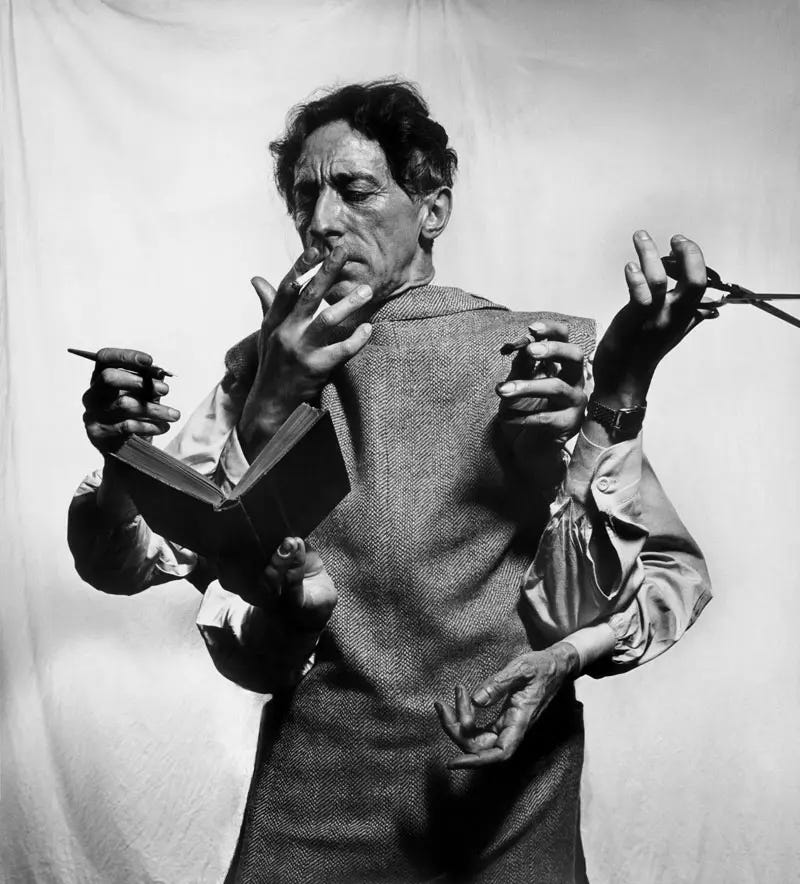
Image credit: Philippe Halsman, Jean Cocteau, New York, USA. 1949. © Philippe Halsman / Magnum Photos.
I call it process porn, because “research” makes it sound responsible.
There’s nothing more titillating to me than learning that Elizabeth Gilbert wrote Morning Pages for a year which led her to discover she wanted to speak Italian. Which later led to Eat Pray Love.
Or that Sue Monk Kidd gathers little “boxes” for each project into which she deposits tiny, talismanic objects which keep her tethered to the energy of her work.
Long before social media, Victor Hugo, horrified at his inability to focus, paid a servant to hide his clothes so he couldn’t leave the house. He wrote The Hunchback of Notre Dame wrapped in a shawl, half freezing, fully at the mercy of his editorial deadline.
Not that writers seem to agree on much…
Natalie Goldberg prefers to write by hand but Stephen King bangs out his novels on a Mac.
Kidd outlines, King doesn’t.
You’ll also find ritualistic substance abuse in the canon - everything from coffee to cocaine and Mezcal.
To hunt for a unifying theory of creativity - some sort of formula one could adopt to ensure success - is as pointless as arguing with a toddler that it is DARTH Vader and not DARK Vader. #askmehowIknow

So why spend so much time, money and attention on these explorations?
Because to zip myself into another writer’s skin, to peer out of their eyeholes, even just for a few paragraphs, is to find a secret tunnel out of the locked room of my own perception.
To be less alone in the wrestle for the meaning trapped inside my words.
Which isn’t to say I advocate being precious about your writing. Quite the opposite - I actually think the fewer caveats, the more writing you’re likely to get done.
If ritualistic writing were a spectrum, I’d probably land closer to the Michael A. Ronn end of things - the “write in sips, dictate while doing the dishes” camp.
But I’ve stopped praying to the Output Gods.
I personally am unable to maintain a healthy, non-self-exploitative relationship with even daily word counts.
ahem
Before we get into this next section, let the record show that I am TOTALLY NOT RESENTFUL that when I finally discovered the holy grail that changed everything, it turned out some Chinese dudes had already written about it like 2,500 years ago.
Yeah. Uh huh.
You see, I’ve become obsessed with the concept of wu wei (pronounced oo-way)- the Taoist idea of “non-doing” or effortless effort.
You do nothing but everything gets done.

Wu wei demands such exquisite presence, such a deep awareness of self and surrounds that one knows exactly what to touch and what to leave alone.
Since I don’t meditate in any formal way, I needed a workaround for “presence.”
Asking does this feel delightful? has guided me more reliably than discipline ever did.
Somehow, delight has done something that word-count trackers and productivity systems never managed to do for me.
It made me consistent.
Not consistent in output…
Consistent in contact.
Because wu wei is NOT about writing only when you feel like it.
Certainly that would make the writing effortless since the pent up inspiration would do all the heavy lifting. In this scenario, one would have no need for discipline at all: Write when you feel like it and not when you don’t.
But what if a part of you feels like writing while a different part throws shade and whines about how you need to spend 3 hours doing research?
Wu wei says to stay in conversation, in connection with the work, but to never force the lock.
So I have only 2 rules now:
1. I must “touch” my project every day
2. I only do what comes easily once inside the project
Which allows me just enough structure that I don’t tip into rigidity and just enough flexibility that I don’t lose focus.
Structure: I’m committed to spending at least 30 mins per day in some sort of active contact with my project. “Active contact” means it’s front and centre and not simply humming in the background.
Flexibility: This means that I am not required to hit any sort of word count. I can edit if that’s what feels closest and most available. Or I can journal or read or even take a walk and think. No forcing, no overreach.
Nothing that will burn me out even when - especially when - when done repeatedly.
Being flexible allows me to me responsive to the other demands of my life.
If homeschool or chronic pain has taken a toll that day, I can pull back. Likewise, if I wake up filled with vigour, and can negotiate the space, I might write for 3 hours.
This way, every fibre of my curiosity gets to weave itself around the process of producing words and feeling for the meaning beneath.
If there is any bigger turn on, I have yet to discover it.
And so finally, my penchant for process porn has led me to something so carnal that I am finally comfortable leaving the lights on.
What’s your favourite way of returning to the page? Tell me in the comments.
Subscribe for hilarious, thought-provoking explorations about a creative process that nurtures you back.
Geeta, we shared the space yesterday in Esmé's Indexing class. So glad it introduced me to your work, I love the ideas you share here. The idea of having contact with the project everyday in some delightful and sustainable form, *chef's kiss* - I'll be borrowing that!